
You set up the crate. Your puppy takes one look at it — and runs in the opposite direction.
Sound familiar? Crate training has a reputation for being difficult, even cruel. But done the right way, it’s one of the kindest things you can do for your puppy. A crate gives them a safe, calm space that’s entirely their own — like a bedroom they can retreat to whenever the world feels too big.
The secret is going slowly, keeping it positive, and never rushing the process.
Here’s everything you need to know.
Why Crate Train at All?
A lot of new puppy owners feel guilty about using a crate. It looks like a cage. It feels mean. But here’s the truth: dogs are den animals by nature. In the wild, they seek out small, enclosed spaces to rest and feel safe. A crate taps directly into that instinct.
When introduced properly, a crate becomes your puppy’s favourite place in the house — not a punishment.
Here’s what crate training actually does for you:
- Prevents accidents — puppies instinctively avoid soiling where they sleep, making crates a powerful toilet training tool
- Keeps them safe — stops unsupervised chewing of dangerous items (cables, shoes, furniture)
- Gives them rest — puppies need 16–18 hours of sleep a day; a crate helps them actually get it
- Prepares them for life — vet visits, travel, kennels, and grooming all involve confinement; a crate-trained dog handles these calmly
- Reduces anxiety — a puppy with their own safe space is generally a calmer, more confident dog
What a crate is NOT: A place for punishment. A crate should never be associated with anything negative. The moment you use it as a “naughty corner,” you undo everything.
Choosing the Right Crate
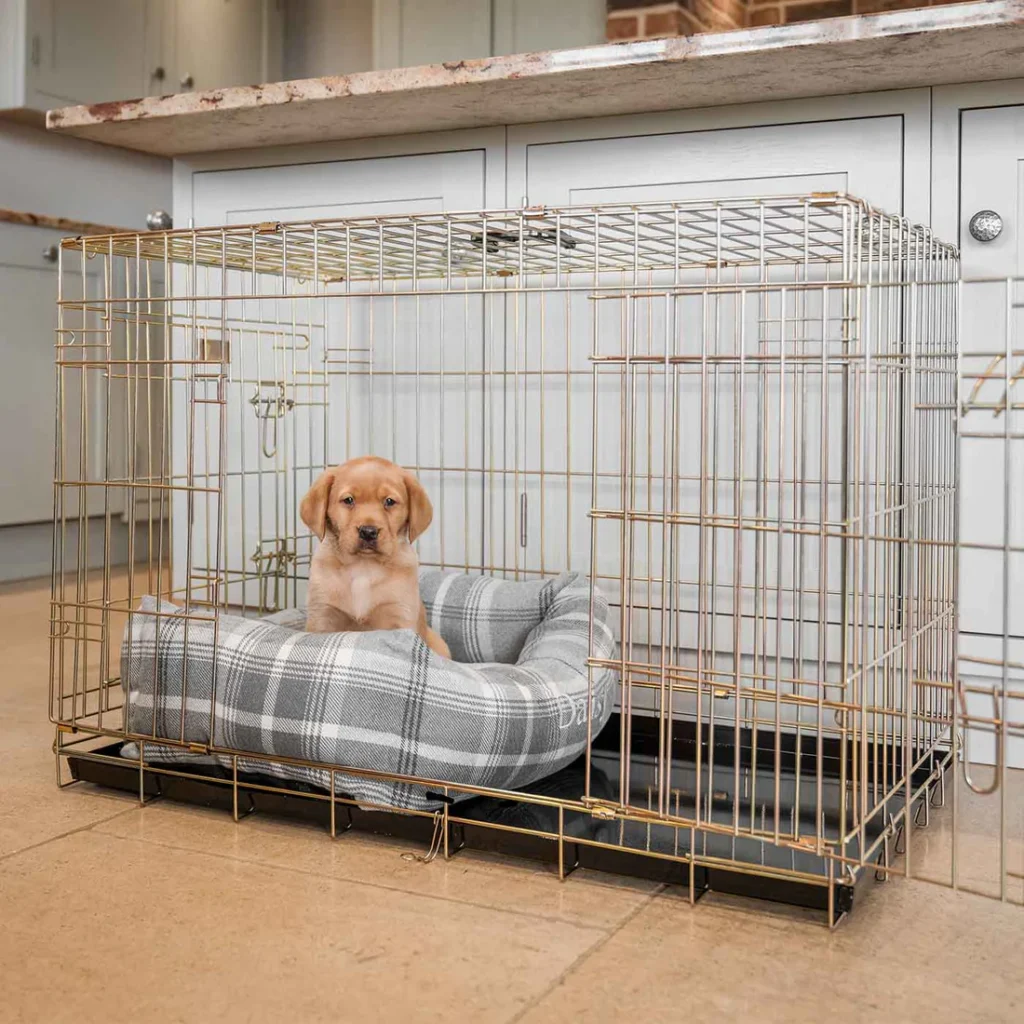
Before you start training, you need the right crate. Get this wrong and the whole process becomes harder.
Size Matters More Than You Think
The crate should be just big enough for your puppy to:
- Stand up without crouching
- Turn around comfortably
- Lie down fully stretched out
That’s it. No bigger.
A crate that’s too large lets your puppy sleep at one end and use the other as a toilet — completely defeating the purpose.
If you’re buying for a large breed: Get a crate with a divider panel. This lets you buy one adult-sized crate and simply section it off as your puppy grows — saving money and keeping the right proportions at every stage.
Types of Crate
| Crate Type | Best For |
|---|---|
| 🔲 Wire crate | Most popular — good airflow, easy to clean, folds flat |
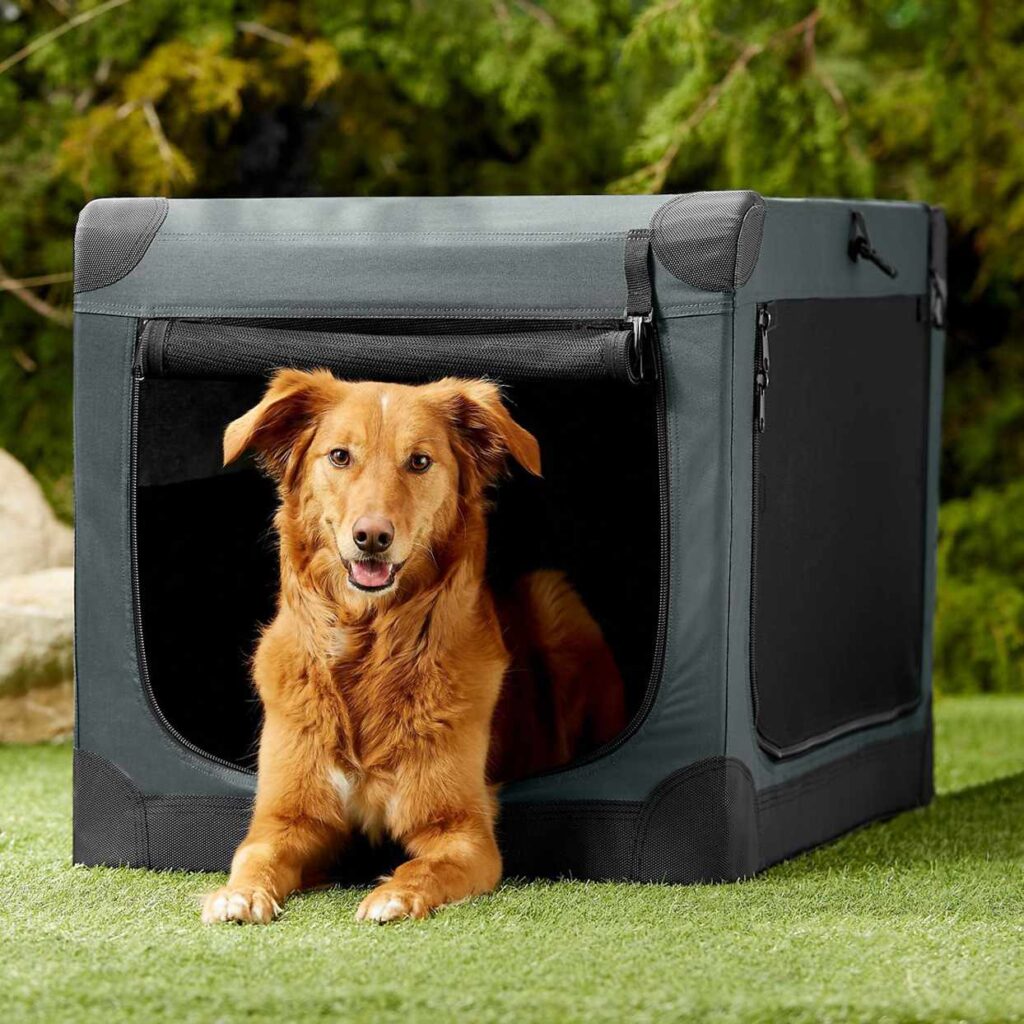
| 🧳 Soft-sided crate | Travel and calm, already-trained dogs |
| 🐚 Plastic travel crate | Dogs that prefer a more enclosed, den-like feel |
| 🪵 Furniture-style crate | Home use where aesthetics matter |
For most puppies, a wire crate with a divider is the best all-round choice.

Where to Put the Crate?
Placement makes a surprisingly big difference — especially in the early days.
During the day: Put the crate in a busy room like the living room or kitchen. Your puppy wants to be near you. A crate that feels like isolation will be much harder to accept.
At night: Move it to your bedroom, or as close as possible. Your puppy has just left their mother and littermates. Being able to hear and smell you provides enormous comfort — and means you’ll hear them if they need a toilet trip in the night.
As your puppy becomes fully comfortable, you can gradually move the crate to wherever suits your home best.
Setting Up the Crate — Make It Irresistible
Before your puppy even goes near the crate, make it the most appealing spot in the room.
What to put inside:
- A soft blanket or bed (ideally one that smells of their mother or littermates if possible)
- A safe chew toy or stuffed KONG
- A worn item of your clothing — your scent is genuinely comforting to them
- A water attachment if they’ll be in there longer than an hour
Cover three sides of a wire crate with a blanket or crate cover — this creates a darker, more den-like atmosphere that most puppies find instantly calming.
Leave the door open and let your puppy discover it on their own terms before any training begins.
The 4-Stage Introduction — Never Skip Steps
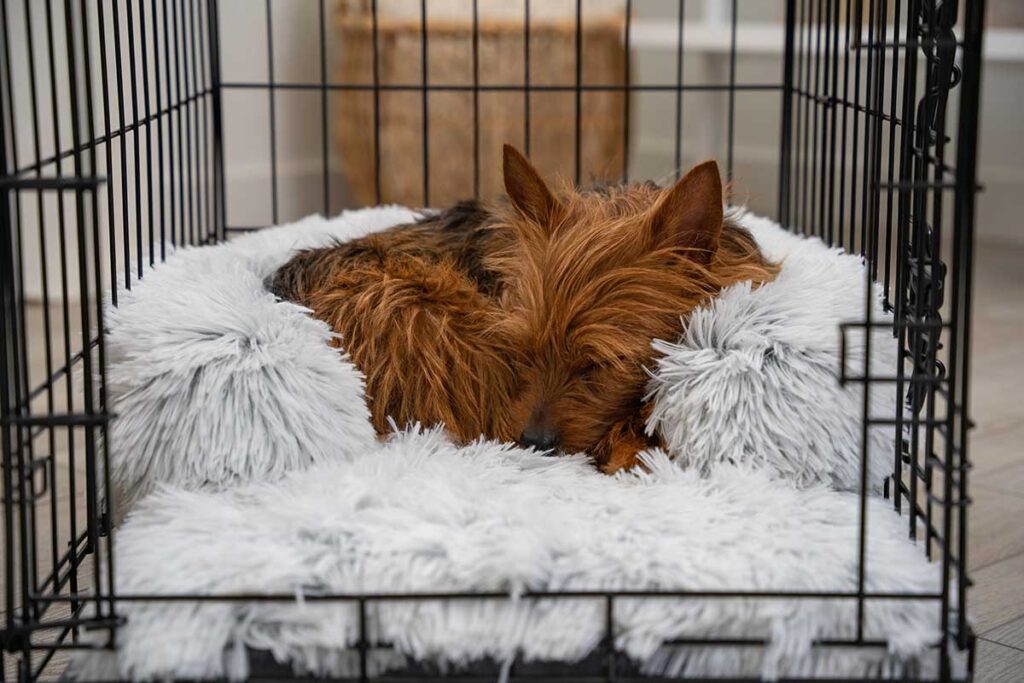
This is the heart of crate training. Rushing any of these stages is the most common reason crate training fails. Go at your puppy’s pace — not yours.
Stage 1: Introduction (Day 1–3)
Goal: The crate becomes a normal, interesting part of the room
- Place the crate in the living area with the door open and do nothing. Let curiosity do the work.
- Toss a few treats near the entrance, then just inside the door
- Let your puppy go in and out freely — never block the exit
- When they voluntarily step inside, calmly praise them: “Good boy!”
- Repeat several times a day, no pressure, no closing the door yet
Some puppies walk straight in on day one. Others take three days of sniffing from a distance. Both are completely normal.
Stage 2: Feeding Meals in the Crate (Day 3–7)
Goal: The crate = good things happen
- Start placing your puppy’s food bowl just inside the entrance
- Each meal, move it slightly further back
- Once they’re walking fully inside to eat, quietly close the door while they eat
- Open it the moment they finish — before they have a chance to whine
- Gradually extend the time the door stays closed: 2 minutes, then 5, then 10
By the end of this stage, your puppy should be trotting into the crate happily at mealtimes.
Stage 3: Longer Stays With You Present (Week 2)
Goal: Your puppy settles in the crate while you’re in the room
- Lure your puppy into the crate with a treat or a stuffed KONG
- Say a cue word as they go in — something like “Crate” or “Bed”
- Close the door and sit nearby, going about your normal activities
- Start with 10 minutes, then build gradually to 30 minutes, then an hour
- Let them out before they get distressed — you want to end on a calm note every time
- If they whine, wait for a brief pause in the whining before opening — opening the door mid-whine teaches them that whining = freedom
A stuffed, frozen KONG is one of the most powerful crate training tools available. Fill it with peanut butter, banana, or wet food and freeze overnight. It keeps puppies busy, calm, and positively occupied for 20–30 minutes — perfect for building up crate time.
Stage 4: Crate Time When You Leave the Room (Week 2–3)
Goal: Your puppy feels comfortable in the crate even when you’re not visible
- Repeat Stage 3, but begin briefly leaving the room
- Start with 30 seconds out of sight, then 2 minutes, then 5
- Build very gradually — don’t jump from 5 minutes to an hour
- Keep arrivals and departures low-key. No big hellos or goodbyes — this reduces the contrast between you being there and not being there
- Work up to your puppy settling for 2–3 hours comfortably during the day
Crate Training at Night
Night-time is often the hardest part — for puppy and owner.
Your puppy has never slept alone before. The first few nights, expect some whimpering. This is normal and doesn’t mean the crate training is failing.
How to make nights easier:
- Place the crate right next to your bed so your puppy can hear and smell you
- Give them a toilet trip immediately before settling them for the night
- Tuck in a warm (not hot) heat pad or a ticking clock wrapped in a blanket — these mimic the warmth and heartbeat of littermates
- When they whine in the night, take them straight outside for a toilet trip — quietly, no fuss, no play, and straight back in the crate
- Don’t bring them into your bed to stop the crying — this teaches them that crying works
Realistic night-time expectations by age:
| Age | Expected Night Sleep |
|---|---|
| 8–10 weeks | 2–3 hours between toilet trips |
| 10–12 weeks | 3–4 hours |
| 3–4 months | 4–5 hours |
| 4–6 months | 5–7 hours |
| 6+ months | Through the night for most puppies |
Most puppies sleep through the night reliably by around 4–5 months. Hang in there.
How Long Can a Puppy Stay in the Crate?
This is one of the most important things to get right.
The golden rule: Maximum one hour per month of age, plus one.
| Age | Maximum Crate Time (Daytime) |
|---|---|
| 8–10 weeks | 1 hour |
| 3 months | 2 hours |
| 4 months | 3 hours |
| 5 months | 4 hours |
| 6+ months | Up to 5 hours (absolute maximum) |
⚠️ Never use a crate as a babysitter. A puppy left in a crate for 8 hours a day will develop anxiety, frustration, and serious behavioural problems. If you work full-time, arrange a dog walker, puppy sitter, or doggy daycare for the hours you’re away.
A Sample Daily Crate Schedule
Here’s what a realistic day might look like for a 10-week-old puppy:
| Time | Activity |
|---|---|
| 7:00am | Wake up → straight outside for toilet → breakfast |
| 7:30am | Supervised play and cuddles |
| 8:30am | Into crate for nap (1–1.5 hours) |
| 10:00am | Outside for toilet → short play and training (10 mins) |
| 11:00am | Crate for nap |
| 12:30pm | Outside → lunch → gentle play |
| 1:30pm | Crate for afternoon nap |
| 3:00pm | Outside → socialisation, exploration, playtime |
| 4:30pm | Crate rest |
| 6:00pm | Outside → dinner → calm evening with family |
| 9:00pm | Final toilet trip → settle in crate for night |
Notice how much crate time — and sleep — is built into the day. This isn’t restrictive. This is exactly what a young puppy’s mind and body need.
Common Crate Training Mistakes to Avoid
| ❌ Mistake | ✅ What to Do Instead |
|---|---|
| Rushing the introduction | Follow the 4 stages — go at your puppy’s pace |
| Using the crate as punishment | Keep it positive, always |
| Leaving them in too long | Follow the age-based time limits strictly |
| Giving in to whining | Wait for a pause before opening the door |
| Making arrivals and departures dramatic | Keep it calm and low-key every time |
| Stopping crate training “because they seem fine” | Keep it consistent until at least 6 months |
| Moving the crate away from the bedroom too soon | Stay nearby until they’re fully settled at night |
What If My Puppy Hates the Crate?
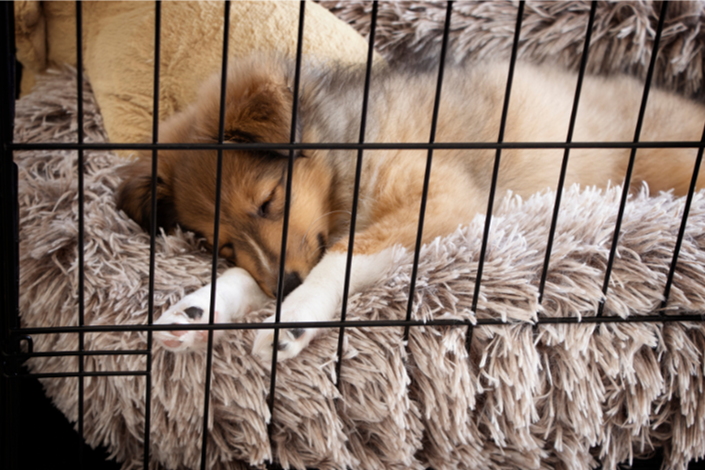
If your puppy is panicking — truly panicking, not just whimpering — rather than just fussing, go back to Stage 1 and start completely fresh. Some puppies need longer at each stage.
Ask yourself:
- Is the crate the right size? Too big and it doesn’t feel like a den
- Is it in the right place? Isolation makes things much harder
- Am I going too fast? Most crate training struggles come from skipping steps
- Is my puppy getting enough exercise and stimulation before crate time? A puppy with pent-up energy will struggle to settle
If genuine distress continues despite going slowly and carefully, speak to a vet or certified trainer — some puppies have underlying anxiety that needs additional support.
The Bottom Line
Crate training is not unkind. Done properly, it’s one of the most loving things you can set up for your puppy — giving them security, routine, and a place in the world that is entirely, comfortably theirs.
The whole process comes down to three things:
- Go slowly — never rush a stage
- Keep it positive — every association with the crate should be good
- Be consistent — the same routine, every day, from everyone in the house
Follow those three principles and most puppies will be happily settled in their crate within two to three weeks. Some fall in love with it even faster.
Be patient, trust the process — and before long, you’ll find your puppy wandering into their crate on their own just to take a nap. 🐶
 by Non Profit Supporters